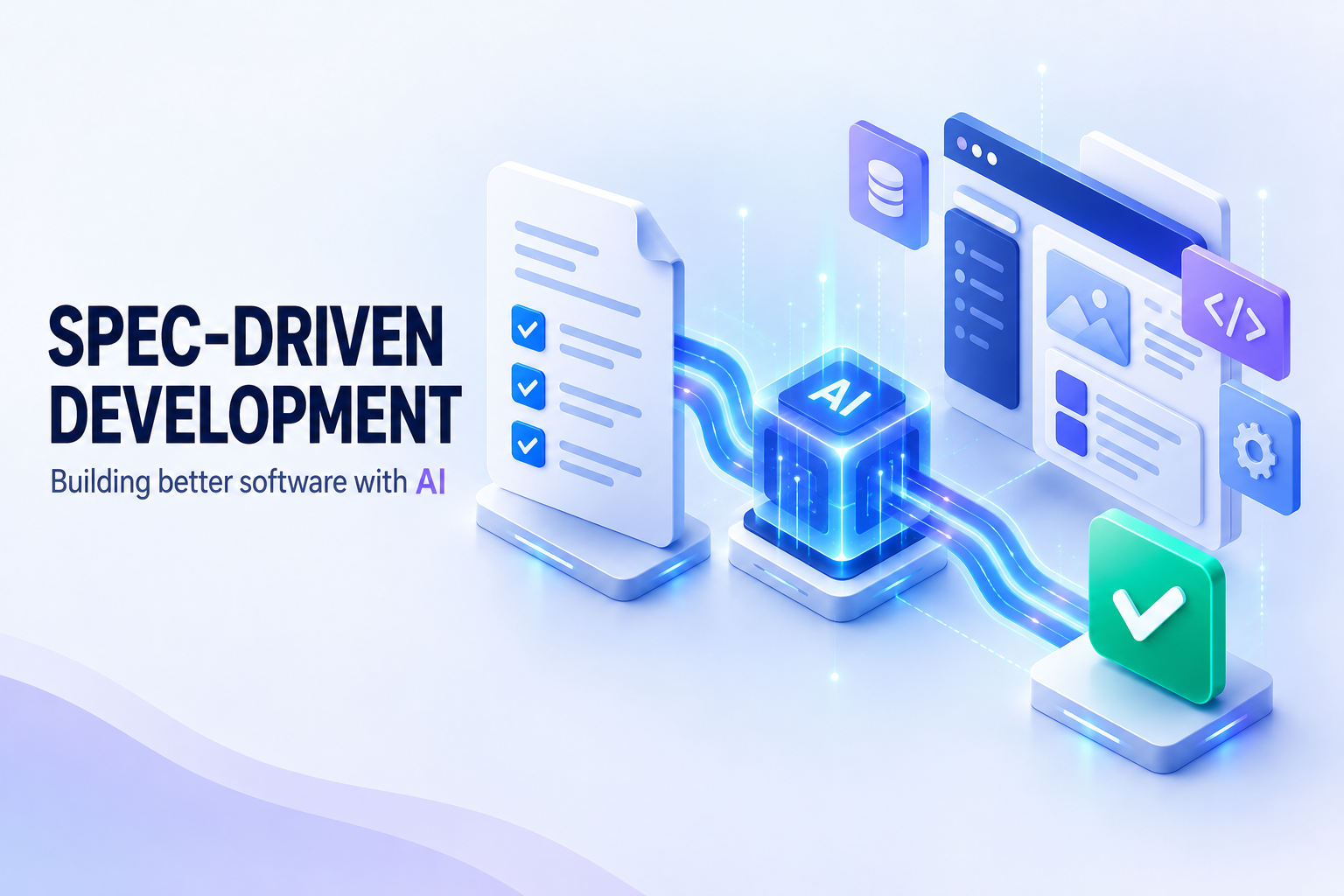
Generating code is becoming easier. Agreeing on what that code should do still takes careful thought. Spec-driven development brings that decision-making into the open: define the expected behavior, plan the implementation, and check the result against the same requirements.
Why this topic matters in 2026
Specification-first thinking has a fresh application in AI-assisted engineering. GitHub introduced Spec Kit as an open-source toolkit for bringing structured specifications into coding-agent workflows. Its current documentation covers defining a feature, planning it, implementing it, and checking that the result converges on the intended outcome. See GitHub's introduction and the Spec Kit documentation.
For product teams, this points to a useful shift in emphasis: invest in a shared definition of success before asking an AI tool to implement it. The workflow below is our practical recommendation, rather than a promise of automatic productivity gains.
What is spec-driven development?
A specification describes the behavior a feature must deliver, the constraints it must respect, and the examples that demonstrate correctness. Developers use that specification to guide implementation and review. In an AI-assisted workflow, it also gives the coding agent an explicit reference for decisions that a short prompt might leave ambiguous.
Keep the product requirement separate from the implementation plan. “Customers can download their own invoices” describes an outcome. Database queries, API routes, and storage choices belong in the plan. This separation lets a team challenge technical choices without accidentally changing the customer promise.
Turn a vague request into a testable feature
Consider a request to “add invoice downloads.” It sounds small, but leaves several decisions unanswered. Which invoices can a user access? What happens while a file is being prepared? Does a failed download leave the page usable?
This small specification exposes product, access-control, and interface decisions before implementation starts. A reviewer can now compare the delivered behavior with explicit expectations.
A practical five-step workflow
- Describe the user outcome. Identify the user, the problem, and the expected result. Include examples, exclusions, and unresolved questions. Resolve consequential ambiguities with the feature owner.
- Inspect the existing system. Find relevant components, interfaces, and conventions. Add concrete references so the plan fits the codebase instead of inventing a parallel architecture.
- Review a short implementation plan. Explain affected components, data changes, failure handling, and verification. For the invoice example, decide where PDF generation runs and how authorization is enforced.
- Implement in reviewable pieces. Separate server behavior, interface changes, and integration where useful. Ask the agent to flag assumptions and report what it actually checked.
- Verify against the specification. Exercise both successful and unsuccessful paths. Review the code and the tests, then confirm the customer experience before release.
Keep the specification useful as requirements change
A document loses value when it describes yesterday's behavior. If invoice downloads later include refunded purchases, update the requirement, examples, and checks together. Make that change visible in the same review as the implementation.
Keep specifications close to the code and give someone responsibility for resolving contradictions. Record meaningful decisions, but avoid turning every small adjustment into a lengthy document. A short, accurate specification is easier to maintain than an exhaustive one nobody trusts.
Where this approach helps—and where to keep it light
Use a fuller specification when a feature crosses several components, has complicated permissions, or depends on agreement between product and engineering. These are situations where a plausible implementation can still deliver the wrong behavior.
For a copy correction or a small visual adjustment, a clear issue with an acceptance example may be enough. Exploratory prototypes can also start with a short hypothesis; revise the specification as the team learns. Match the documentation effort to the uncertainty and consequence of the change.
Measure whether it improves delivery
Pilot the workflow on a few comparable features. Record time spent clarifying requirements, implementing changes, reviewing work, and fixing defects. Look for fewer repeated misunderstandings and less rework after review. Count the cost of writing and maintaining the specifications too.
The aim is a shared definition of success that survives the journey from idea to production. Start with one feature, write its acceptance examples, and use those examples throughout implementation and review.
Related reading: AI Coding Agents in 2026. Planning a software project? Talk to Encodework about turning your requirements into a working product.