AI Coding Agents in 2026: From Issue to Reviewed Pull Request
AI assistance is moving beyond code completion. Coding agents can inspect a repository, propose changes, run tools, and prepare work for review. For development teams, the useful question is how to turn that capability into dependable software delivery.
Why coding agents are a current development trend
GitHub's February 2026 introduction of Agentic Workflows describes repository automation driven by instructions in Markdown and executed by coding agents in GitHub Actions. Its examples include issue triage and documentation maintenance. This shows how agent capabilities are extending into the everyday work around code. Read GitHub's announcement.
JetBrains also examined coding-agent adoption in its August 2026 research, discussing how developers are using this category of tools. Together, these developments make agent-assisted engineering a timely topic for teams planning their development processes. Read the JetBrains research.
The workflow below is our practical guidance for evaluating these tools. It is not a claim that every team will see the same productivity gains.
What changes when an assistant becomes an agent?
A completion tool suggests code while a developer works. A coding agent can attempt a larger task by repeatedly reading context, modifying files, and checking results through available tools. The exact capabilities depend on the product and the permissions it receives.
That changes the developer's work: the quality of the task description, repository documentation, test suite, and review process matters as much as the initial prompt. An agent can produce plausible code that misunderstands a business rule, so a successful tool run is only one part of acceptance.
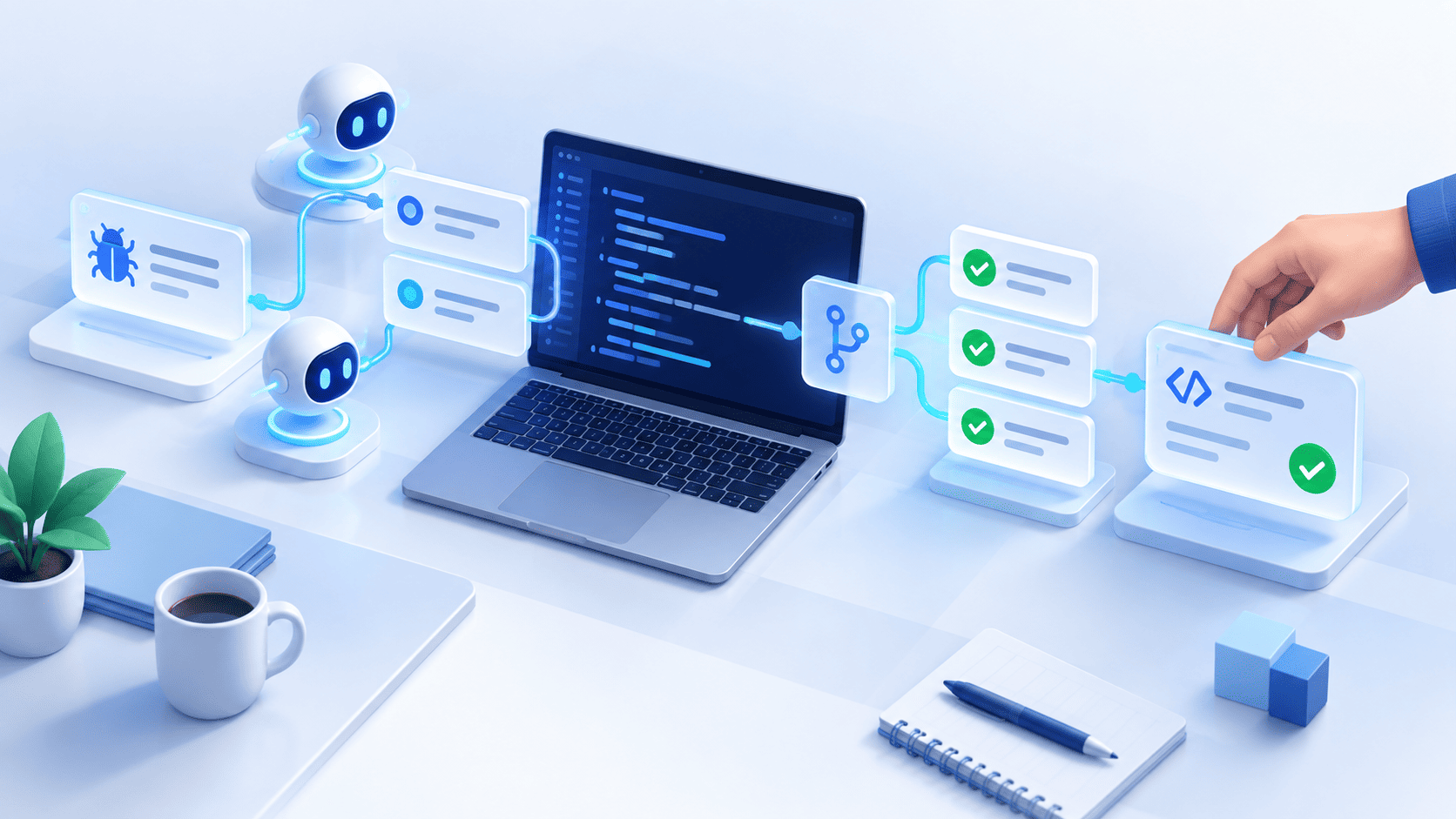
A practical workflow: issue, implementation, checks, review
- Define the outcome. Describe the observed problem, expected behavior, affected users, and acceptance criteria. Include a reproducible example and identify anything that should stay outside the task.
- Provide repository context. Document setup commands, architecture boundaries, coding conventions, and relevant tests. Point to an existing implementation when consistency matters.
- Request a small change. Give the agent one bounded task on an isolated branch. Ask it to explain its approach before changing behavior across multiple components.
- Check the behavior. Run the relevant tests, type checks, and lint rules. For a bug fix, verify that a regression test fails before the fix and passes afterward. Inspect the tests themselves for missing cases.
- Review the complete diff. Check business logic, failure paths, dependencies, and unintended changes. Require a developer to approve the pull request, then use the team's normal release process.
Choose a useful first project
Start with a task that is easy to inspect and has a clear expected result. Updating documentation after an API change, reproducing a reported bug, or adding missing coverage to a stable module can reveal how well an agent understands your repository.
Avoid making an ambiguous architecture rewrite your first experiment. If a human reviewer cannot quickly establish whether the result is correct, it is difficult to learn whether the agent improved the process. Break broader work into smaller, independently reviewable changes.
Keep permissions and verification explicit
Give agents only the repository and tools needed for the task. Use isolated development environments and test credentials. Keep production access, destructive operations, and release approval behind the team's established controls.
Treat issue comments, retrieved documents, and external content as information to evaluate. Instructions found inside that content should not automatically gain authority over the task. Review new dependencies and unexpected network calls just as carefully as application code.
Automated checks are valuable, but they cannot prove that a feature solves the right problem. Include manual acceptance checks for user-facing behavior and make unresolved assumptions visible in the pull request.
Measure delivery outcomes
Run a small pilot with comparable tasks and record the full effort involved. Time spent correcting prompts, reviewing patches, and repairing regressions belongs in the evaluation alongside time spent generating code.
- Lead time: How long does a task take from assignment to an accepted change?
- Review effort: How much developer time is needed to understand and revise the result?
- Reliability: How often do accepted changes cause regressions or require rollback?
- Total cost: What do tool usage, execution infrastructure, and human supervision cost per accepted task?
Compare these outcomes with your existing process before expanding usage. A higher volume of generated code is not, by itself, evidence of better delivery.
Build a process your team can trust
AI coding agents give software teams another way to move from a clear requirement to a reviewable implementation. Their value depends on the surrounding engineering practices: precise scope, useful context, meaningful tests, and accountable human review.
For a first step, choose one repository, one task category, and a short evaluation period. Keep what improves accepted delivery and refine what adds review overhead.
Planning an AI-assisted development workflow for your product? Talk to Encodework about your software development needs.